

As the natural world undergoes rapid changes, it is crucial for humanity to have reliable and accurate predictions about its behavior to mitigate harmful impacts on society and ecosystems. Ecosystems of various scales face increasing vulnerability to collapse. For instance, coral reefs are suffering from warming waters, pollution, and overfishing; globally, 84% of reefs experience coral bleaching, which displaces or kills marine life, reduces biodiversity, and negatively affects economies reliant on tourism and food supplies.
Anticipating these harmful effects is essential for creating effective control and mitigation strategies, an area where artificial intelligence (AI) and machine learning could significantly contribute. However, the lack of sufficient ecological data poses challenges for effectively training machine learning models. Arizona State University electrical engineering student Zheng-Meng Zhai is addressing this challenge by exploring ways to leverage AI for better predictions and prevention of ecosystem failures.
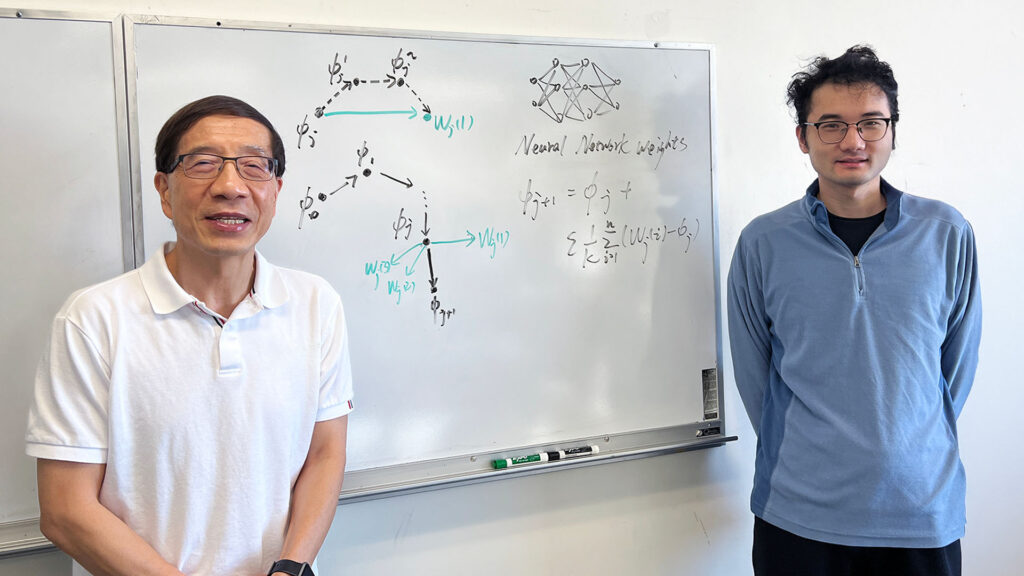
Zhai, a student in the Ira A. Fulton Schools of Engineering, led a project aimed at teaching AI algorithms to make accurate predictions about ecological systems, which often lack adequate data. His research, supervised by ASU Regents Professor Ying-Cheng Lai, was selected for publication in the Proceedings of the National Academy of Sciences of the United States of America (PNAS) for its significance.
Zhai noted that traditional machine learning generally requires extensive data to function effectively, leading him to pursue methods that produce good predictions even when data is limited. His research has shown how to enhance the accuracy of machine learning algorithms, allowing them to operate effectively with five to seven times less data than typically needed. This improved accuracy applies to areas that use time series data to track measurements over time, including climate research like modeling ocean currents.
Zhai pointed out that the Atlantic Meridional Overturning Circulation (AMOC), a significant ocean current system, has only short and incomplete records of its behavior. He emphasized that if AMOC weakens or collapses, it could have substantial global consequences. His method could potentially aid in better predictions of such phenomena. Additionally, his findings could be relevant for modeling disease outbreaks, assisting public health authorities, and predicting traffic patterns for smoother transportation planning.
To address these issues, Zhai and Lai developed a meta-learning method that enables machine learning algorithms to learn in different ways. Unlike traditional methods, which focus on a single robust dataset for a specific task, meta-learning trains algorithms to draw on experiences from various related tasks. Zhai utilized chaotic synthetic datasets to simulate realistic, unpredictable scenarios for this purpose.
By training the algorithms with these datasets, the machine learning system can learn to make inferences from ecological systems with minimal data. This learning capability is supported by a time-delay feed-forward neural network, designed to function like the human brain.
As he prepares to defend his doctoral thesis, Zhai’s development of the meta-learning method is part of a productive academic career. He has published over ten papers in respected journals like Nature Communications and PRX Energy, and he plans to expand his research to predict various types of system behaviors, including instabilities in climate systems, ecosystem collapse, and infrastructure networks.
Professor Lai remarked that Zhai has emerged as a leading expert in applying machine learning to complex dynamical systems, highlighting his status as a promising figure in this interdisciplinary field. Zhai expressed his honor at having his work published in PNAS, viewing it as a significant milestone in his academic journey, and hopes it will inspire future research on data-limited systems.
—