
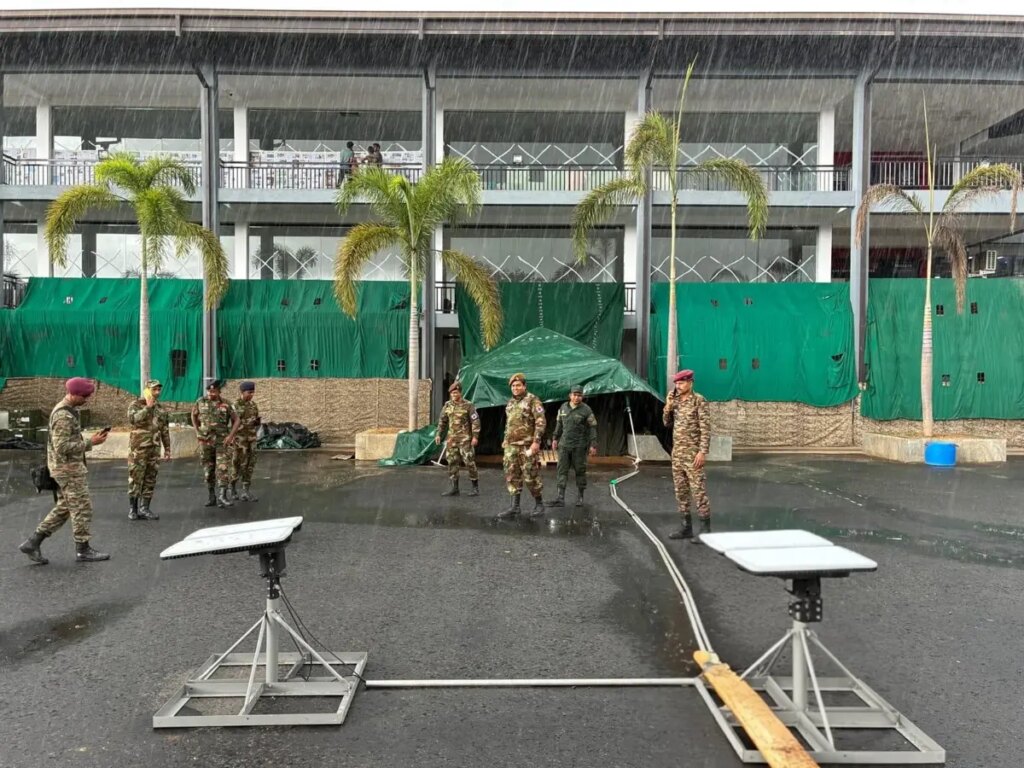

Since November 28, 2025, the Indian Armed Forces have been actively involved in providing humanitarian aid and disaster relief to cyclone-affected Sri Lanka. The impact of Cyclone Ditwah, along with subsequent landslides and floods, resulted in over 600 fatalities. The Indian Army has successfully utilized satellite-based internet connectivity as an emergency measure to restore reliable communications in areas where traditional networks have been severely affected.
This satellite connectivity facilitates round-the-clock telemedicine consultations with specialist medical teams, allowing the Army to deliver crucial healthcare and emergency assistance to impacted communities without delay. The initiative underscores the vital role of robust, rapid satellite infrastructure in reinstating essential services during disaster response.
European company Eutelsat, in collaboration with the Indian firm Airtel, is extending OneWeb’s Low Earth Orbit (LEO) satellite connectivity to support the ongoing humanitarian relief efforts in flood-impacted regions of Sri Lanka.
Neha Idnani, Regional Vice President for APAC at Eutelsat, emphasized the company’s strong commitment to aiding the Indian Army’s relief operations through OneWeb connectivity. She stated that maintaining high-quality communications in crisis situations is crucial and that they aim to provide secure, resilient connectivity necessary to safeguard lives and facilitate essential services.
For several decades, both military and civilian users have relied on satellite internet and telephony services, employing devices that connect to large communication satellites located 36,000 kilometers above the Earth. These geostationary satellites provide substantial coverage due to their altitude, appearing stationary from the Earth’s surface. However, their distance introduces some latency, making them less suitable for applications requiring rapid response, like HD video conferencing or online gaming.
In recent years, LEO satellite constellations have gained popularity, with companies such as Eutelsat OneWeb operating fleets comprised of hundreds, if not thousands, of small satellites positioned between 400 to 1,200 kilometers above the Earth. Although a single satellite can cover only a small area at a time, Eutelsat-OneWeb’s fleet of over 640 satellites enables significant global coverage. This closeness allows for more rapid internet signal transmission, facilitating high-speed services in remote areas and on moving platforms like airplanes and ships.
Conventional communication infrastructure often fails to serve sparsely populated regions effectively due to high costs. An LEO satellite fleet can bridge these connectivity gaps, and numerous companies, including Starlink and Amazon’s Project Kuiper, are competing in this market, aiming to eliminate internet connectivity blind spots.
These LEO-based constellations also cater to military needs, offering improved capabilities compared to traditional communication satellites in higher geostationary orbits.
—