
The Institution of Agricultural Engineers (IAgrE) artificial intelligence (AI) conference highlighted significant differences in AI adoption between livestock and arable farming. IAgrE member Declan Flynn, an expert in AI and robotics, noted that dairy AI systems can provide hourly savings, while AI applications in crop farming often take entire seasons to show their value.
One notable example is DeLaval’s automated milking technology, which uses AI to adjust parameters 20 times per second during harvesting operations. Kieran Fitzgerald, vice-president of digital services at DeLaval, described this technology as akin to a “Fitbit for a cow,” creating digital replicas of farms. The company’s disease risk models can detect issues like mastitis and ketosis earlier than traditional methods, with AI adoption reaching 20-25% in established dairy markets.
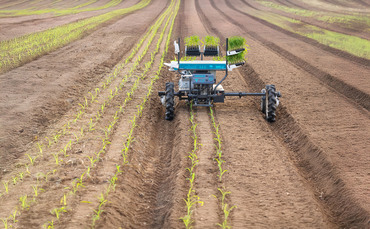
In contrast, precision agriculture tools, such as variable rate fertilizer maps, may take two years to demonstrate savings, although spray applications can yield benefits twice per season. Jonathan Henry, managing director of Garford Farm Machinery, showcased how Garford’s Robocrop AI system effectively identifies weeds using AI, although the return on investment timeline differs from livestock applications. Paul Smith, a farmer utilizing AI systems, reported simplified operations and measurable savings, but acknowledged the difficulty in proving business cases across various farming sectors.
A heated topic at the conference was whether farmers should profit from their agricultural data. Professor Simon Pearson from Lincoln University argued that farmers should own their data and receive compensation. He suggested creating data trusts structured as Community Interest Companies, allowing farmers to sell anonymized data while retaining control.
Conversely, Fernando Auat Cheein, a robotics expert from Harper Adams University, claimed there was no sustainable business case for selling individual farm data, advocating for data sharing based on crop type and farm size. This discussion highlights broader concerns regarding data security as farms become more connected.
Kieran Fitzgerald emphasized the responsibility of companies to protect farm data and adhere to regulations like the EU Data Act. Morten Bilde, managing director at AGCO, noted the importance of edge computing in harsh farming conditions to mitigate risks and suggested that essential information should be accessible locally.
Delegates were informed that while standardization and data sharing could accelerate AI development, the issues of compensation and control over farm data remain unresolved.
—