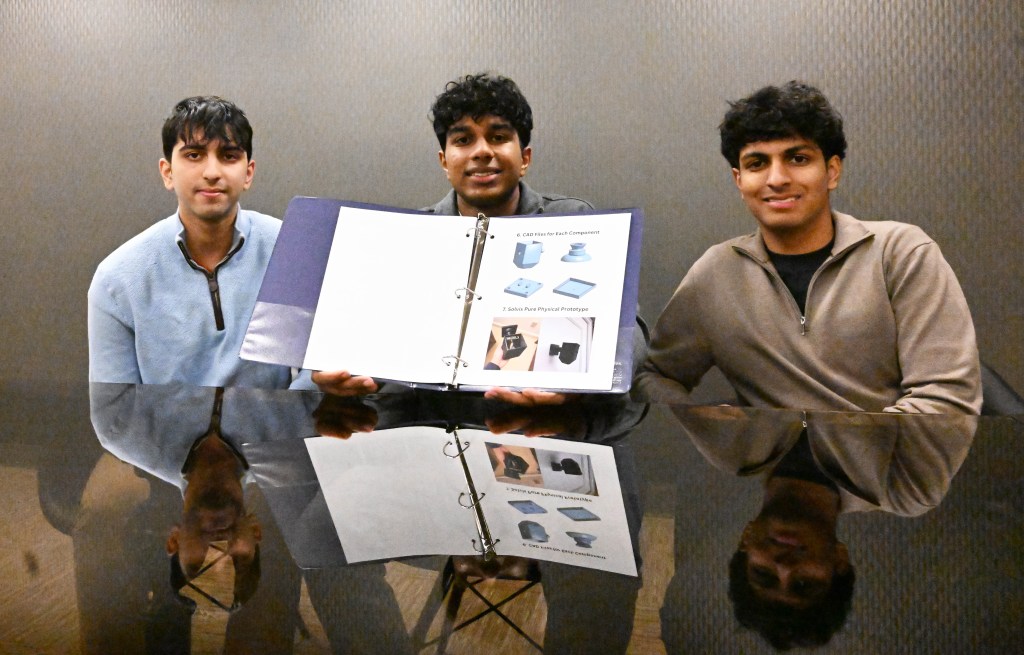

It took nearly 18,000 photos to train an artificial intelligence algorithm to detect hazardous materials in construction runoff. The 17-year-old founders of Solvis now have a computer vision product that can help companies reduce pollution.
The three Moravian Academy students behind Solvis have won thousands of dollars in pitch competitions and aim to place test cameras at 25 construction sites by the end of next year. “It’s about confidence, really,” said Aveer Chadha. “First, we believe in our solution.”
The product, Solvis Pure, is a camera that monitors construction sites and uses a proprietary algorithm to analyze data. It alerts companies via a mobile app if hazardous runoff is approaching or exceeding regulatory limits.
The issue of harmful construction runoff was identified during a walk along the Lehigh River. Chadha and co-founders Nikhil Skandan and Qayn Jaffer had been brainstorming startup ideas when they noticed pollutants flowing from a construction site into the river. Their research revealed the significant environmental damage caused by construction runoff. A notable statistic from a 2015 study indicates that the industry contributes to 40% of drinking water pollution.
Chadha explained that the problem is two-sided: construction not only harms the environment but also leads to fines from the Environmental Protection Agency. Tasdemir Marble and Granite provided photos for the students to train their algorithm, which has shown 91.2% accuracy in identifying materials in runoff.
Tony Mattei, director of entrepreneurship at Penn State Brandywine, highlighted that Solvis is addressing a community-based problem. Mattei oversees the Brandywine LaunchBox, a service offering resources to early-stage startups. The LaunchBox partnered with the Ideas X Innovation Network to host a pitch competition where Solvis won a $2,000 Rising Entrepreneur prize. “They really shined in this competition,” Mattei said.
Moving forward, building customer connections and partnerships will be crucial for Solvis. Mattei noted that government grants could help engage environmental regulators, potentially leading to contracts with construction firms. The Lehigh Valley construction industry is collaborative, and Jaffer mentioned that tapping into this network is part of their strategy. “Building reliability and utilizing word-of-mouth marketing is what has carried us so far,” Jaffer said.
The LionCage win was Solvis’ second victory in November, following a $10,000 Be More Fund grant achieved at the National Society of High School Scholars Day in Atlanta. Real-world application of their concept is the next challenge for the founders, according to i2n Director Matt Cabrey, who stated that consistent success would elevate the organization.
Thus far, Solvis has relied on Skandan’s expertise in robotics and coding to develop their devices and refine the mobile app that generates monitoring data. Scaling production poses challenges, particularly in acquiring costly cameras that produce high-quality images for identifying materials in runoff. Skandan emphasized the need for cost-effective growth strategies.
Starting a business has introduced new challenges, but Skandan believes their discoveries can positively impact society. “They can be scalable to actually help people and create a better world,” he said.
—