
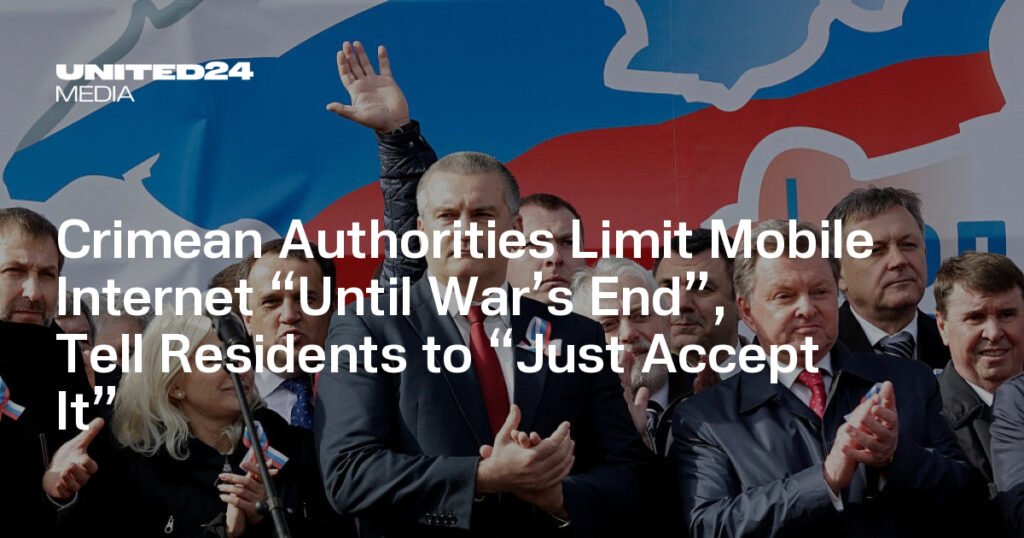

Russian-installed authorities in temporarily occupied Ukrainian Crimea have implemented long-term restrictions on mobile internet access, set to last until the conclusion of Russia’s full-scale war against Ukraine. Sergey Aksyonov, the Russian-appointed head of Crimea, announced this on December 23.
Aksyonov stated that residents would need to adapt to this new reality, emphasizing that these measures are necessary for Crimea’s security. He remarked that there is “no other way” to proceed and noted that the internet serves both beneficial and harmful purposes.
These restrictions follow prior actions taken by Crimea’s mobile operator, Volna, which limited access to WhatsApp and Telegram, in accordance with directives from Russia’s media watchdog, Roskomnadzor. Local officials mentioned that the shutdowns of mobile communications and internet services during drone attacks are coordinated with federal authorities.
Crimea is now the second region in Russia where residents have effectively lost mobile internet access until the war concludes. In November, the Ulyanovsk region adopted a similar measure, citing federal decisions to expand a “security zone” around key facilities.
Russian leader Vladimir Putin has defended mobile internet shutdowns, asserting they are vital for security. During a televised Q&A, he claimed that foreign-based internet services could assist Ukraine in selecting targets for drone strikes, although he did not clarify the mechanics behind this assertion.
Mobile internet disruptions have increased since spring, particularly during Ukrainian drone strikes, with some regions experiencing extended outages. In mid-December, mobile internet in Saint-Petersburg was reportedly unavailable for over a week, with officials stating that security agencies manage or restrict access based on operational needs.
Amid these interruptions, Russia’s Ministry of Digital Development has established a “white list” of over 60 websites and services expected to remain accessible during shutdowns. This includes major banks, marketplaces, state-aligned media outlets, and domestic social networks. However, reliability varies by region, leading to challenges for many Russians in paying for goods, remote work, or using ride-hailing services.
It has also been reported that the Security Service of Ukraine (SBU) successfully targeted key components of Russia’s air defense systems at the Belbek military airfield in occupied Crimea, utilizing long-range drones to inflict significant damage on valuable assets.
—