

LANSING, Mich. — This year has seen a significant increase in artificial intelligence, coinciding with a growing demand for data centers—large facilities essential for powering AI technology.
While data centers are not a new concept, industry insiders report that the current growth in the sector is unprecedented. Major tech companies are investing billions to construct new data centers as they pursue AI’s potential.
Development proposals have surged in various Midwest states, including Michigan. Lawmakers have likened the race for AI superiority to the space race, emphasizing the need to outpace China. Former Google CEO Eric Schmidt has stressed the importance of America leading in AI development.
Schmidt noted the transformative impact of these systems, which could lead to human-level intelligence and potentially even “super intelligence” within a decade. He highlighted the economic benefits of data centers for areas that typically experience slower growth.
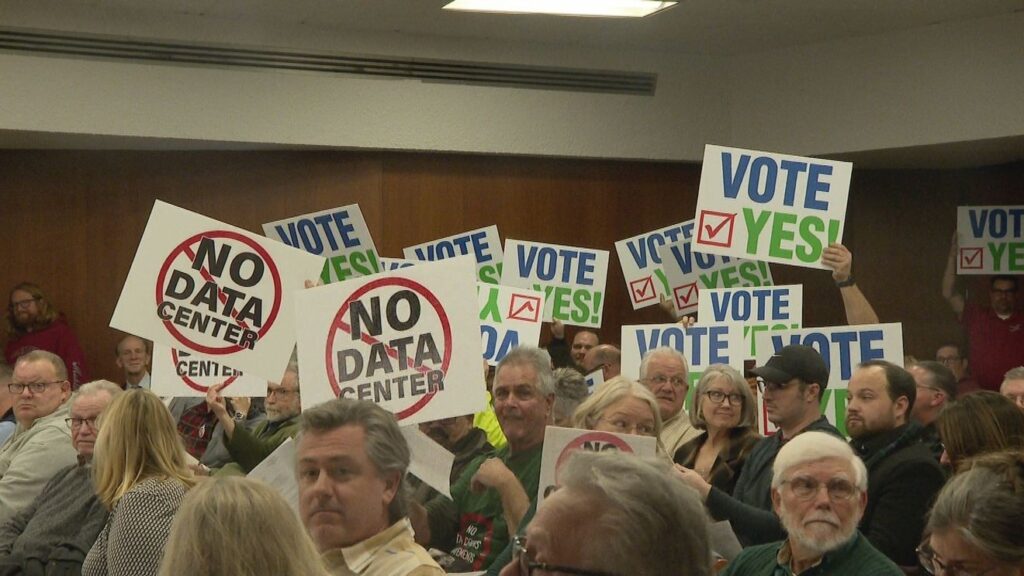
However, while supporters argue that data centers are vital for technological advancement and local investments, critics raise concerns over potential health and environmental risks. Various Michigan communities facing zoning inquiries for data centers in 2025 have expressed widespread opposition to such developments.
News Channel 3 has reported on engaged community meetings regarding data centers, including protests at the State Capitol. Residents have voiced concerns about environmental impacts, such as water supply, pollution, and electric grid capacity, primarily due to the immense energy needs of data centers.
Katie Duckworth, a senior associate attorney with the Environmental Law and Policy Center (ELPC), noted that citizens are demanding transparency about who benefits from data center developments. ELPC advocates for a balance between technological progress and the preservation of Michigan’s natural resources.
Duckworth emphasized the importance of proactive planning, including setting incentives and mandates for companies to cover their electric costs while using environmentally sound technologies.
For instance, Chris Schrock, a senior energy engineer, explained two cooling methods for data centers: open-loop and closed-loop systems. Open-loop systems use water from local sources to absorb heat but may result in significant water consumption. Closed-loop systems recirculate water, thereby conserving it but requiring more energy to operate.
Most new data centers in Michigan are being designed with closed-loop systems. Schrock stated, “Closed-loop systems conserve water, but they require a lot more electricity.”
Data centers are significant electricity consumers, prompting concerns among some, while others see them as potential catalysts for community investment and improved electric grid infrastructure. Brandon Hoffmeister, Consumers Energy’s senior vice president, reassured that data centers should not raise customers’ electric rates and could contribute to necessary infrastructure enhancements.
Utilities engineers prepare well in advance for new high-demand customers, ensuring the electric infrastructure can accommodate future needs. Schrock highlighted the necessity for careful planning and regulation of data center developments.
Public meetings across West Michigan reflect strong local sentiments regarding choice, transparency, and community protection. More data center proposals are anticipated to be submitted to the Michigan Public Service Commission by 2026.
Looking ahead, technology leaders are exploring innovative concepts, including the possibility of locating data centers in space. The Lansing Board of Water and Light recently proposed a project to capture waste heat from data centers for use in the city’s district heating system. This initiative aims to decrease natural gas consumption by repurposing heat generated during data processing.
As Michigan and the Midwest grapple with the expansion of AI-driven infrastructure, residents are determined to remain actively involved. At a recent hearing in Marshall, a resident asserted, “We’re going to do whatever it takes.”
—