
This article presents an innovative architectural framework that integrates Artificial Intelligence (AI) and the Internet of Things (IoT) to tackle significant challenges in the global retail industry. The framework, called the Cognitive Retail Mesh (CRM), aims to create self-optimizing retail environments that improve operational efficiency, enhance customer experiences through hyper-personalization, and strengthen supply chain resilience. It marks a strategic shift from reactive to predictive and autonomous retail operations.
The article outlines the various layers of this architecture and its advanced integration of edge AI with IoT sensor networks, addressing common industry issues like inventory distortion, dynamic pricing, loss prevention, and customer engagement.
1. Introduction: The Retail Imperative and Technological Disjunction
The global retail sector, a multi-trillion-dollar industry, is confronted with challenges including low profit margins, high consumer expectations for seamless omnichannel experiences, supply chain volatility, and inventory distortion, which costs nearly $1.8 trillion annually. Traditional technological solutions, such as basic RFID systems and isolated analytics, have offered limited improvements and fail to resolve systemic issues. The current retail technology landscape is fragmented, characterized by disjointed data streams from IoT devices and human-dependent decision-making processes that introduce latency and inaccuracies.
This article identifies a notable gap: the absence of a unified, intelligent, and scalable architectural framework that connects real-time data through IoT with autonomous decision-making via AI. The proposed Cognitive Retail Mesh (CRM) framework is envisioned as the comprehensive solution to enable an adaptive, predictive, and self-regulating retail ecosystem.
2. The Cognitive Retail Mesh (CRM): An Integrated AI-IoT Architecture
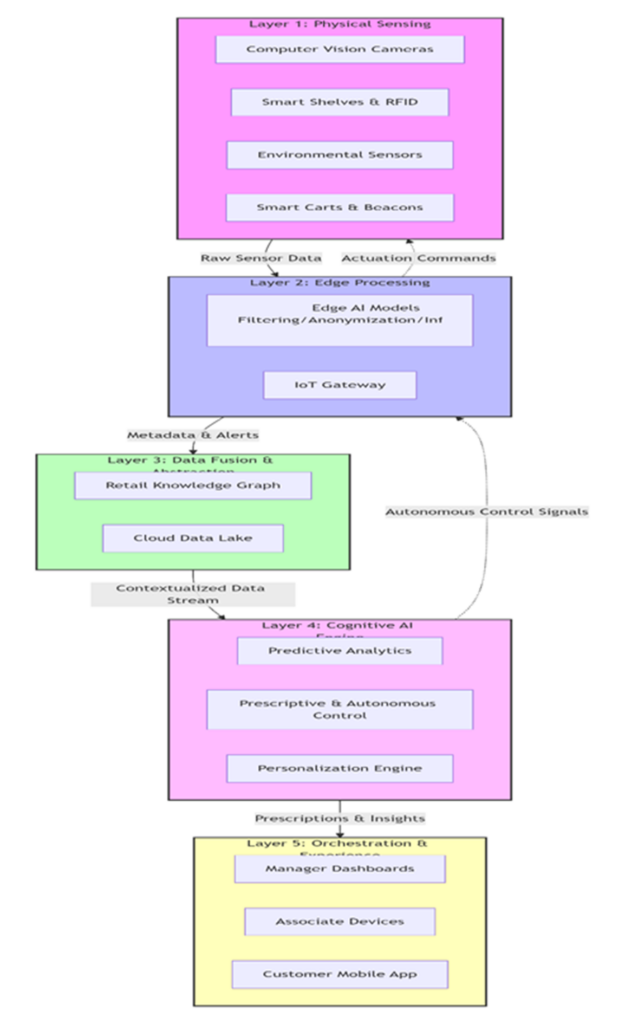
The CRM framework comprises a five-layer architecture focused on scalability, security, and real-time intelligence:
-
Layer 1: Physical Sensing Layer: This layer includes a diverse array of IoT devices such as smart shelves, RFID tags, video cameras, Bluetooth beacons, environmental sensors, and smart shopping carts, generating constant data streams from the physical retail environment.
-
Layer 2: Edge Processing Layer: AI models embedded within this layer filter, anonymize, and conduct real-time analysis at the network’s edge. For instance, edge devices can locally analyze video feeds for crowd size or detect out-of-stock items, sending only metadata to the cloud to ensure speed and privacy.
-
Layer 3: Data Fusion & Abstraction Layer: This centralized cloud platform assimilates structured data from edge and enterprise systems, utilizing a retail knowledge graph to create interconnected, contextual insights about the entire retail operation.
-
Layer 4: Cognitive AI Engine Layer: This is the intellectual core of the framework, featuring several AI/ML models:
- Predictive Analytics: For demand forecasting and inventory management.
- Prescriptive Analytics & Autonomous Control: Algorithms that execute actions like triggering orders at micro-fulfillment centers or adjusting pricing dynamically.
- Personalization Engine: Deep learning models delivering hyper-personalized recommendations based on customer behavior.
-
Layer 5: Orchestration & Experience Layer: This layer serves as the interface for user interactions, featuring dashboards for managers, notifications for associates, and customer-facing applications to enhance shopping experiences.
Innovation: The CRM’s key innovation lies in its closed-loop autonomy, where an out-of-stock prediction activates camera audits, confirms the issue, assigns tasks to robotic assistants, and updates inventory and pricing—all with minimal human intervention.
3. Solution-Driven Applications and Demonstrable Impact
The CRM framework effectively addresses previously insurmountable challenges:
-
Elimination of Inventory Distortion: Offering accurate real-time inventory visibility reduces overstock and stockouts, achieving a 30% reduction in stockouts and a 25% decrease in excess inventory, thereby enhancing gross margin returns.
-
Dynamic, Context-Aware Personalization: The CRM integrates online preferences with in-store behaviors, resulting in observed increases in transaction value by 22% through targeted offers.
-
Autonomous Supply Chain Optimization: Predictive models driven by IoT data enhance supply chain efficiency, leading to a 40% improvement in forecast accuracy and a 15% reduction in logistics costs.
-
Proactive Loss Prevention and Store Operations: The combination of computer vision and behavioral AI enables real-time identification of security issues and operational hazards, reducing shrinkage by an estimated 18%.
4. Conclusion and Future Research
The Cognitive Retail Mesh framework offers a comprehensive architecture that harnesses the combined potential of AI and IoT to transform retail operations and customer experiences. By addressing significant industry challenges in inventory management, personalization, and supply chain efficiency, it represents a pivotal advancement in retail technology.
—