
Introduction
Samsung concluded 2025 with significant achievements. The Galaxy S25 series surpassed previous generations in sales, and Samsung’s foldable devices gained immense popularity.
However, beneath this success are challenges. Despite the S25’s popularity, it experienced minimal upgrades, with the S25 Edge not meeting expectations.
On the foldable front, the Z Flip7 and Z Fold7 introduced essential enhancements to the Z series, while the Galaxy Z TriFold made an impressive debut as a commercially available tech demo.
Winner: Samsung Galaxy S25 Ultra
The Galaxy S25 series had a robust performance, particularly the Galaxy S25 Ultra, which set a pre-order record in South Korea with 1.3 million units. This surpasses previous personal bests for the series, although the overall record still belongs to the Galaxy Note10.
Months after its launch, the Galaxy S25 Ultra outsold its counterparts, with 5.08 million units sold compared to 2.41 million S25 units and only 1.67 million Plus models. By June, the S25 series outperformed the S24 series by 12.2%. The Ultra model also saw a 7.1% increase in sales over the S24 Ultra.
Sales patterns show a consistent rise, as the S24 Ultra exceeded the S23 Ultra, which in turn outsold the S22 series. While the camera upgrades were minimal and the S Pen saw a downgrade, the S25 Ultra emerged as one of the most popular models in recent years.
Winner: Samsung Galaxy S25
The Samsung Galaxy S25 showed the most improvement over its predecessor, recording 11.6% higher sales compared to the S24. Although it didn’t reach the popularity of the Ultra model, it significantly outperformed the Plus model, with 6.07 million units sold versus 3.85 million.
The S25’s key upgrade was moving to 12GB of RAM, while storage remained at 128GB. Performance benefited from the Snapdragon 8 Elite chipset, making it an all-Snapdragon series, which likely contributed to its success.
Loser: Samsung Galaxy S25+
The Samsung Galaxy S25+ didn’t perform well in sales, earning it a “survivor” label rather than a victory. There were indications that Samsung planned to discontinue the Plus model in favor of the Edge, but with rumors of the S26 Edge being canceled, the Plus model may return next year, although its popularity remains uncertain.
Loser: Samsung Galaxy S25 Edge
Sales reports for the Samsung Galaxy S25 Edge indicate poor performance, leading to speculation that plans for a 2026 Edge may have been scrapped. The concept of an ultra-slim phone seems to have failed in the market, as shown by the lackluster reception to the iPhone Air’s design.
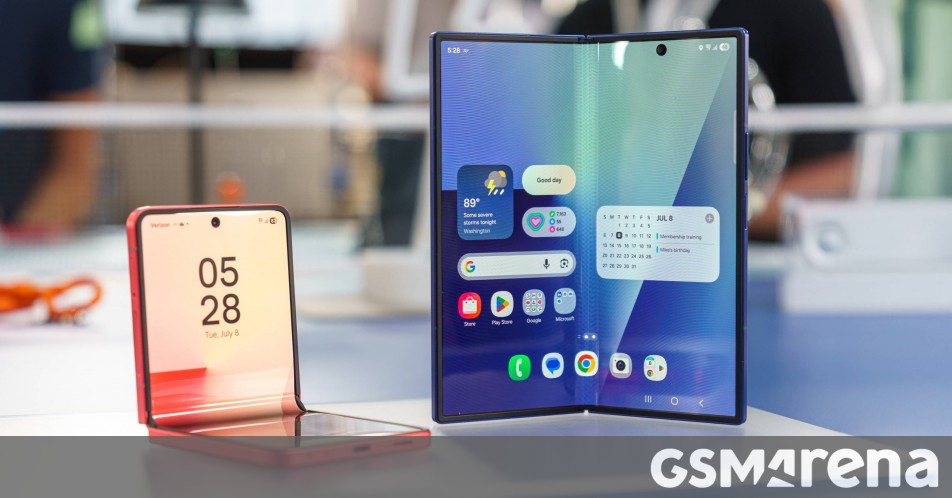
Winners: Samsung Galaxy Z Fold7 and Samsung Galaxy Z Flip7
According to Counterpoint Research, global foldable shipments increased by 14% in Q3 2025, with the Galaxy Z Fold7 and Z Flip7 as top sellers. Samsung shipped 32% more foldables compared to the previous year, achieving a 64% market share, significantly ahead of competitors like Huawei.
Buyers are increasingly transitioning from standard phones to foldables, with around 30% of Z Fold7 purchasers upgrading from an S Ultra. The Z Fold7 also outsold the previous model by over 50%, while the Z Flip7 attracted more customers from other brands than any previous model.
While improvements are forthcoming for future generations, the Z Fold7 and Z Flip7 dominate the foldable market for 2025.
Winner: Samsung Galaxy Z TriFold
The Galaxy Z TriFold isn’t the first of its kind, but its broader availability and lower price may position it as the best-selling tri-fold phone in 2025. Nevertheless, it will be produced in limited quantities. The launch represented a renewed commitment to innovation from Samsung.
Loser: Exynos
The only phone utilizing the Exynos 2500 chipset is the Galaxy Z Flip7, and while it performs well, its success isn’t attributed to the chipset itself. Delays in the launch meant that the S25 series missed out on using the 2500.
Rumors suggest a bleak future for the Exynos 2600, expected to only be used in South Korean Galaxy S26 units due to a deal with Qualcomm mandating that at least 75% of S26 phones use Snapdragon chips. The Exynos lineup has struggled in recent years, particularly in the flagship segment.
Loser: Samsung Galaxy S25 FE
The Samsung Galaxy S25 FE delivered a modest update, changing the chipset from Exynos 2400e to Exynos 2400, although the performance bump felt minimal. A price increase placed the S25 FE too close to the S25+, complicating its marketability.
Loser: Samsung Galaxy Z Flip7 FE
While specific sales data for the Z Flip7 and Z Flip7 FE are unavailable, it’s clear that the latter struggled in popularity, largely due to its outdated design and specs. The Z Flip7 FE didn’t succeed as hoped.
Winners: Samsung Galaxy A56 and A36
Although specific sales figures are lacking, the Galaxy A36 and Galaxy A56 were recognized as significant growth contributors for Samsung in Q2. The strategy to launch the Galaxy A56 in the US was a shift from past years, although its release was delayed until mid-July.
Losers: Samsung Galaxy Watches
Samsung did not debut a new Galaxy Watch Ultra this year, instead rebranding the 2024 model with minor changes. The Galaxy Watch8 and Galaxy Watch8 Classic faced backlash for their design and display size, particularly regarding the rotating bezel dimensions.
—